The short answer: SPC-core luxury vinyl plank and porcelain tile are the two flooring types that reliably hold up to Florida humidity on a concrete slab. Solid hardwood and standard laminate are the two to avoid. LVP typically costs less and installs faster; tile typically costs more but wins on heat resistance and wet-area durability.
Almost every whole-home flooring call we get starts the same way: a homeowner replaced flooring once already, and it did not hold up — edges lifting near a slider, grout that never looks clean, or a laminate seam that started bubbling within a couple of years. Florida's humidity is not gentler than people expect; it is harder on flooring than most manufacturers' marketing accounts for. Here is what actually performs on the Treasure Coast, and what to skip.
What is the best flooring for Florida humidity?
Two materials consistently perform well on a Florida slab: SPC-core luxury vinyl plank and porcelain tile. Both are effectively waterproof, both stay dimensionally stable as humidity swings from a dry, air-conditioned winter day to a soupy August afternoon, and neither depends on a sealing schedule to keep performing. Everything else on the market is a tradeoff against one of those two properties.
- SPC luxury vinyl plank. A rigid stone-plastic composite core that will not swell or flex, a realistic wood-look wear layer on top, and a floating click-lock install that goes down fast. The practical, budget-friendly default for living rooms, bedrooms and hallways.
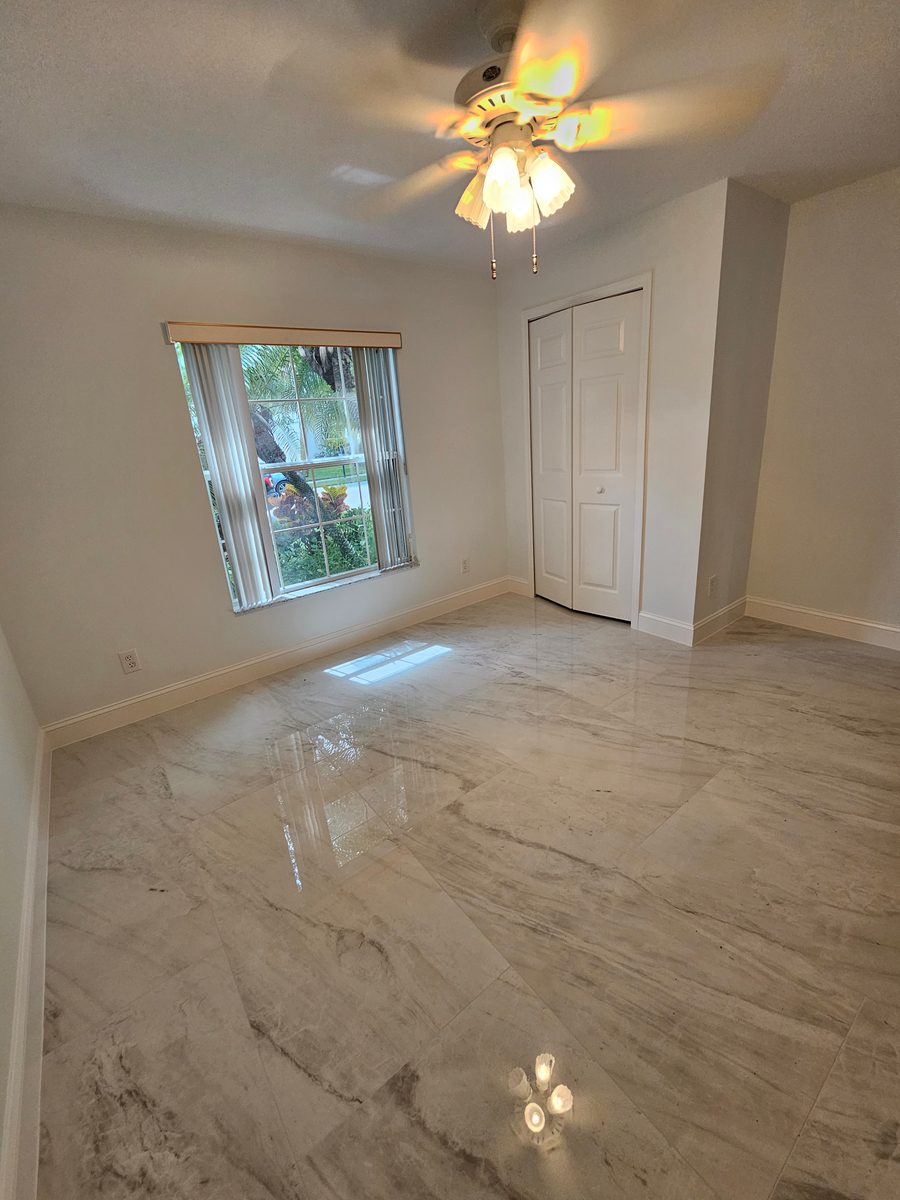
- Porcelain tile. Absorbs almost no water, is naturally cool underfoot in summer, and — installed correctly with a proper waterproof membrane where it matters — is the closest thing to a flooring material that simply does not wear out in this climate.
- Engineered hardwood — conditioned interior rooms only. Built in layers rather than solid milled wood, so it resists the swelling that ruins solid hardwood here, but it still belongs in a consistently air-conditioned room, never near a slider, a lanai, or anywhere moisture gets in regularly.
What flooring should you avoid in a Florida home?
Two materials cause the most callbacks we see from other companies' installs:
- Solid hardwood. It absorbs and releases moisture with the seasons no matter how well it is finished, and on a Florida slab that shows up as cupping, gapping, or warping — sometimes within a single humid summer.
- Standard laminate. The core is high-density fiberboard, and fiberboard swells once moisture reaches the seams. We regularly see lifted edges and bubbling at the joints in laminate floors that are only a few years old in a Florida house.
Cork behaves similarly to laminate in high humidity and is not a material we recommend here either, outside of a small, fully conditioned interior space.
Luxury vinyl plank or tile — which is better for a Florida home?
Both hold up. The right choice usually comes down to the room:
| Where it wins | LVP | Tile |
|---|---|---|
| Install speed | Faster — floating click-lock planks | Slower — set and grouted |
| Underfoot feel | Warmer, softer, quieter | Cool, harder |
| Wet areas | Waterproof, good performer | The stronger choice for daily standing water |
| Heat resistance | Good | Best — will not soften or dent |
| Maintenance | Sweep and mop, no sealing | Easy to clean; grout lines need attention over time |
On most of the whole-home projects we build, homeowners mix the two: LVP through living areas, bedrooms and hallways, tile in bathrooms, laundry rooms and any space that regularly sees water on the floor. See what our whole-home remodeling service includes →
What does whole-house flooring typically cost in Vero Beach?
The honest answer is that it depends on the material, the square footage, and what has to happen before the new floor goes down — old flooring removal and any slab moisture mitigation both add to the total. As a general guide, LVP typically runs toward the lower end per square foot installed, and porcelain or ceramic tile typically runs higher per square foot given the labor of setting and grouting it. Large-format tile adds more labor time than a standard size. We measure the actual space and give you one written number before anything is ordered — the ranges above are a starting point for budgeting, not a quote.
What we recommend
For most whole-home flooring projects on the Treasure Coast, we default to SPC luxury vinyl plank through the main living spaces and bedrooms, and porcelain tile in bathrooms, laundry rooms, and any area with a door to the outside. That split gives you a warmer, faster, more budget-friendly floor where you spend the most time, and the most water-resistant material exactly where you need it. If a specific room has unusual sun exposure, a slab moisture issue, or you are set on a wood look throughout, tell us during the estimate — we will walk you through where a substitution makes sense and where it is a mistake waiting to happen.
How flooring fits into a larger renovation
If you are already remodeling a kitchen or bathroom, matching the new flooring across connected spaces avoids an awkward transition strip in the middle of an open floor plan. Flooring generally gets sequenced after wet trades and drywall are done and inspected in each room, and before final trim and paint. See our guide to sequencing a multi-room remodel →
Cabinetry is the other big Florida-humidity decision most whole-home projects run into at the same time as flooring — plywood boxes over particleboard, for the same reason LVP beats laminate. If you are also weighing kitchen cabinets, see our cabinet refacing vs. replacement guide →
Flooring across the Treasure Coast
Urban Remodeling installs flooring for homeowners in Vero Beach, Sebastian, Fort Pierce, Port St. Lucie, Stuart and Melbourne — as part of a whole-home project or on its own. The estimate is free, and you get a written scope and material recommendation before anything is ordered. See what our kitchen remodeling service includes →
Thinking about this project?
We’ll walk the space with you, talk through what actually holds up in your home, and put a written price in front of you. No cost, no pressure.
Call (772) 404-8397 Request a Free Estimate