
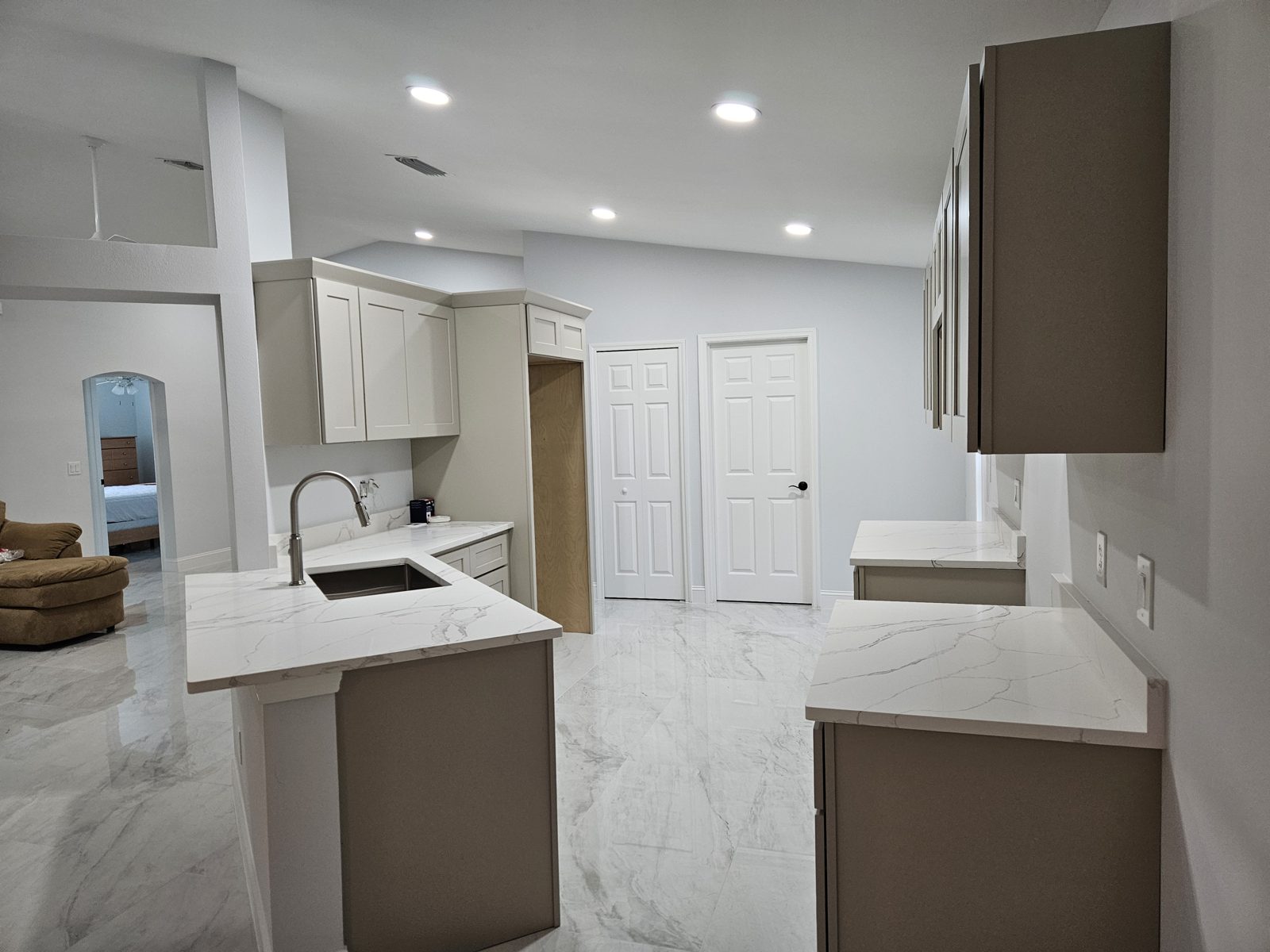
Quartz is the lower-upkeep choice because it is non-porous and never needs sealing. Granite is heat-resistant and every slab is unique, but it needs periodic resealing. If you want a countertop you can wipe down and forget, pick quartz. If you value a one-of-a-kind stone and will keep up the sealing, pick granite.
At Urban Remodeling, we talk this through with homeowners planning a kitchen remodel in Vero Beach, Sebastian and the surrounding towns. This guide compares the two by day-to-day upkeep, not by looks, so you can decide how much work you want to sign up for.
What does quartz need to stay looking good?
Quartz needs very little. Because it is non-porous, liquids do not soak in, and it never needs sealing. A soft cloth, mild soap and water handle most daily cleaning.
That matters in a Florida kitchen, where kids, coffee, wine and cooking oil all end up on the counter. A spill sits on top of the surface until you wipe it up. You do not need to schedule a sealing day or remember when the last one was.
Quartz still has limits. Treat it gently in these ways:
- Use a trivet or pad under hot pots and pans.
- Skip harsh cleaners and abrasive pads that can dull the surface.
- Use a cutting board, since knives can scratch any counter.
- Wipe up spills the same day, especially anything that stains, like turmeric or dark sauces.
Most quartz comes in a steady, even pattern, so two slabs from the same line look much alike. That makes it easier to plan a long run of counter, and easier to match if you add to the kitchen later.
What does granite need?
Granite needs periodic resealing. It is a natural stone with tiny pores, and a sealer fills those pores so liquids do not soak in and leave stains. Over time, the sealer wears down and has to be renewed.
The upkeep itself is not hard. You clean with mild soap and water, and you reseal the surface from time to time. A simple test is to put a few drops of water on the counter. If the water beads up, the sealer is working. If it soaks in and darkens the stone, it is time to reseal.
The trade-off is that granite gives you something quartz cannot: every slab is unique. The veining, flecks and color shifts are natural, so no two kitchens look alike. Some homeowners enjoy that enough to accept the extra care.
Because slabs vary, we suggest you look at the actual slab, not a small sample. A sample can look very different from the full piece once it covers a whole island. Our guide on how to choose kitchen countertops for Florida homes goes through more about the choice.
Which one handles heat and spills better?
Granite handles heat better. It is heat-resistant, so a warm pan is less of a worry. Quartz handles spills better, since it never needs sealing and liquids stay on the surface.
The two materials trade strengths, so it helps to think about how you cook and live:
- You cook a lot and set hot pans down fast: granite is more forgiving, though a trivet is still a good habit.
- You have kids, pets or lots of spills: quartz is easier because there is nothing to seal.
- You entertain and serve red wine or oily food: quartz keeps spills on the surface, and sealed granite does the same as long as the seal is fresh.
- You forget routine chores: quartz fits better, since it never needs sealing.
Florida adds its own wrinkle. Humid air, salt air near the coast and sandy feet all end up in the kitchen. A surface that wipes clean fast earns its place. An unsealed granite top, though, can pick up stains faster, so the sealer is doing real work.
How do you choose for your household?
Choose quartz if you want the least upkeep and the same look slab to slab. Choose granite if you want a natural, one-of-a-kind stone and heat resistance, and you are fine resealing it from time to time.
Ask yourself three questions:
- How much maintenance am I willing to do each year?
- Do I want a pattern that is even, or one that is different on every slab?
- How rough is my cooking, and do I use trivets?
If you answered "as little as possible," quartz is the safer pick. If you answered "I want it to look natural," granite earns a closer look. Neither choice is wrong. They suit different habits.
If you are updating more than the counters, our whole-home remodeling page shows how a kitchen fits into a larger plan. Counter choices also affect cabinet color, flooring and backsplash, so it helps to decide early.
What should you ask before you pick a slab?
Ask to see the full slab, ask what upkeep the material needs, and ask how seams will be placed. These questions keep surprises off your job.
Bring these to the showroom or your estimate:
- Can I see the whole slab, not only a sample?
- How often should this material be resealed, if at all?
- What cleaners are safe for it?
- Where will the seams fall, and how visible will they be?
- How does the edge profile affect cleaning and chipping?
For granite, check the slab for variation in color and veining, because the piece you see is the piece you get. Our post on how countertops get made, from templating to install explains what happens after you choose.
Urban Remodeling gives you one written scope and price before work starts, so your countertop material, edge and install are all listed in one place. We serve Vero Beach, Sebastian, Fort Pierce, Port St. Lucie, Stuart and Melbourne. Call (772) 404-8397 to schedule a free estimate, and bring photos of the counters you like.
Thinking about this project?
Call for a free estimate. We’ll walk the space with you and put a written price in front of you.
Call (772) 404-8397 Request a Free Estimate